
The Supplement Brand Builder Index™
May 2026
Rising transportation costs create short-term friction, but brand launch interest remains resilient. Strong market demand and positive
long-term consumer demand expectations continue to support new and existing supplement brands.
Each month, Pure Private Label analyzes anonymized inbound supplement brand inquiries, customer conversations, launch requests, supplier polling, and brand owner polling to identify what founders are trying to build, where demand is moving, and what is blocking brands from getting to market.
Executive Summary
The May 2026 Supplement Brand Builder Index continues to track market, brand, and founder trends based on Pure Private Label’s anonymized inquiry data, customer conversations, quote requests, customer activity, and optional brand owner polling.
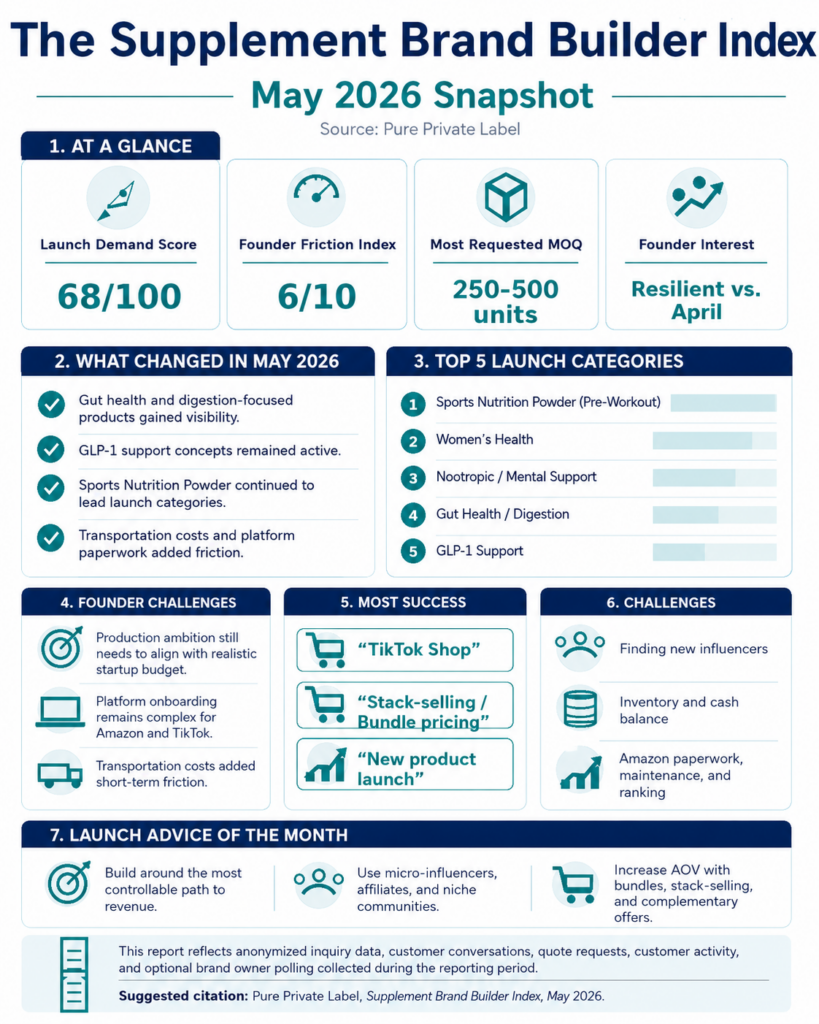
The May report reflects a supplement launch market that remains active, but slightly more measured than April. Founder interest continues to be supported by demand across broadened wellness categories, including gut health, digestion, GLP-1 support, women’s health, nootropic and mental support, and sports nutrition. While the Supplement Launch Demand Score declined modestly to 68/100, overall brand launch activity remains resilient, with founders continuing to pursue niche product opportunities and low-MOQ paths to market.
What is happening in the supplement brand industry right now?
- May 2026 supplement launch demand remained strong, with continued interest in sports nutrition, women’s health, nootropic and mental support, gut health, digestion, and
GLP-1 support concepts.
- Health & Wellness categories continued to gain momentum, with gut health and digestion-focused products emerging as a stronger area of founder interest this
- The most requested MOQ remained between 250–500 units, reinforcing continued demand for accessible, low-MOQ launch options among new and growing supplement
- The Founder Friction Index remained at 6/10, driven by ongoing onboarding requirements for platforms such as TikTok and Amazon, large MOQs for custom packaging, and increased transportation costs.
What changed this month?
May showed continued movement toward broadened wellness categories. Gut health and digestion-focused products gained visibility among founders, while GLP-1 support concepts remained active. Sports Nutrition Powder, especially pre-workout, continued to rank as a leading launch category, but founder interest is increasingly spreading into more specific health, lifestyle, and performance niches.
New and first-time founders remain focused on finding practical ways to launch with limited budgets, while existing brand owners are concentrating on growth tactics such as TikTok Shop, bundle pricing, stack-selling, new product launches, influencer acquisition, inventory management, and Amazon performance.
Market Insight:
Increased transportation costs and platform-related requirements are creating additional friction for supplement founders, but they do not appear to be dissuading new brands or existing brands from pursuing launches. Market demand remains strong, and long-term consumer demand expectations continue to support founder confidence.
The smallest-budget founders remain the most sensitive to added costs, including transportation, custom packaging, platform onboarding, testing, and marketplace paperwork. Larger-budget founders and experienced brands appear better positioned to absorb these costs and continue moving forward with product development and launch strategies.
Recommendation for founders:
New founders should continue to focus on simple, focused launch strategies that align product ambition with realistic startup budgets. For smaller launches, direct-to-consumer channels such as a brand-owned website may offer a more practical starting point than immediately prioritizing larger platforms with higher onboarding complexity.
Founders entering crowded categories should focus on clear audience positioning, strong flavor or product experience, ingredient quality, and a specific use case. For low-budget or early-stage launches, grassroots marketing, micro-influencers, affiliates, creative bundle offers, and niche community engagement may create more efficient traction than trying to compete broadly from day one.
Supplement Launch Demand Score
68/100
The May 2026 Supplement Launch Demand Score is 68/100, riding the trend of supplement support for broadened wellness categories including gut health, digestion, GLP-1 Support products, and sports nutrition.
What is the average requested MOQ for a supplement brand launch?
The most requested MOQ is between 250-500 units, which is well-below manufacturer industry average.
What is the biggest challenges for first-time supplement founders?
Based on Pure Private Label’s monthly inbound inquiry data, the most common challenge for first-time supplement founders is remains aligning production ambition with startup budget.
Founders often want custom formulas, premium packaging, and low first-run quantities but need help choosing the simplest product path that can launch quickly and profitably.
Top 5 Product Categories Brand Owners are Trying to Launch right now
What supplements are brand owners launching right now?
- Sports Nutrition Powder (Pre-Workout)
- Women’s Health
- Nootropic/Mental Support
- Gut Health/Digestion
- GLP-1 Support
What is the best category for a small/mid size brand?
The small and mid-sized brands that continue to find traction and build are in Niche Health & Wellness spaces – especially products serving women’s health, niche hobbies/sports, or a trending category such as collagen. We have begun seeing additional growth this month among Gut Health and Digestion-focused products among founders too.
What is the best category for a new brand?
New brands with clear marketing strategies in Sports Nutrition continue to find a foothold and begin earning market share. Rising stars for new launches include underserved or niche markets such as pickleball, racing, stock trading, sexual health (non-erection), and endurance sports.
Founder Friction Index
6/10
The May 2026 Founder Friction index remains at 6/10, driven by holding onboarding requirements including paperwork and costs for platforms such as TikTok and Amazon. Large MOQs for custom packaging and increased transportation costs contribute to the index as well.
What should new founders know about market conditions?
Increased paperwork and sometimes costs associated with listing or testing products for onboarding with sales platforms such as TikTok and Amazon increases budget needs for new founders as well as demand for sophisticated manufacturing partners for founders. These updates are pushing many new-founders or smaller companies to focus on D2C platforms such as their own e-commerce site (ex. Shopify) driving traffic from social media.
What is the best way for a new founder or low-budget founder to start?
New founders should focus their marketing plans and efforts on lower cost or lower barrier to entry platforms such as their own website to drive sales. Consider grassroots,
micro-influencers, and other creative marketing strategies that create real visibility for lower cost.
Brand Owner Poll
Where did you see the most growth in your business in May 2026?
Most Common Answers:
“TikTok Shop”
“Stack-Selling” or “Bundle-pricing” “New product launch”
What is your biggest challenge running your supplement brand?
Most Common Answers:
“Finding new influencers” “Inventory and cash balance”
“Amazon paperwork/maintainance/ranking”
Launch Advice of the Month
New founders launching supplement brands should build their first launch plan around the most controllable path to revenue. With transportation costs, platform onboarding requirements, Amazon paperwork, and TikTok Shop complexity adding friction, smaller brands should avoid building a launch strategy that depends entirely on large platforms from day one.
Instead, founders should focus on a clear niche audience, a simple product offer, and a direct path to customer acquisition. A brand-owned website, micro-influencer partnerships, affiliate relationships, grassroots communities, and in-person selling opportunities can help new brands create early traction without taking on unnecessary platform costs or complexity.
Existing brands should look for ways to increase average order value and repeat purchasing through bundle pricing, stack-selling, new flavor launches, and complementary product offers. In a strong but competitive market, the brands that win are not always the ones with the broadest product line. They are often the brands that understand their audience clearly, create simple offers, and make it easy for customers to buy more than one product at a time.
Want to Launch a Supplement Brand?
Pure Private Label helps supplement founders and growing brands develop powders, capsules, and custom formulas with low minimum order quantities and expert launch support.
Visit pureprivatelabel.com or contact [email protected] to discuss your project.
About Pure Private Label
Pure Private Label is a Georgia-based supplement manufacturer helping entrepreneurs, creators, practitioners, and growing wellness brands launch high-quality private label and custom supplement products. The company specializes in powders, capsules, and custom formulations, with flexible low minimum order quantities designed to make supplement brand ownership more accessible.
Through formulation support, manufacturing guidance, packaging options, and launch-focused customer service, Pure Private Label helps brands move from idea to finished product with a practical, founder-friendly process.
To learn more about launching a supplement brand or developing a custom formula, or questions about this report visit contact [email protected] or visit www.pureprivatelabel.com
Methodology & Disclaimer
The Supplement Brand Builder Index is based on anonymized Pure Private Label inquiry data, customer conversations, quote requests, customer activity, and optional brand owner polling collected during the reporting period. Personally identifiable information is excluded.
This report reflects brand-side demand, product launch interest, and supplement founder sentiment. It does not represent retail sales performance, consumer medical outcomes, or claims about product efficacy. The information is provided for educational and informational purposes only and should not be interpreted as medical, legal, regulatory, or financial advice.
Suggested Citation
When referencing this report, please cite:
Pure Private Label, Supplement Brand Builder Index, April 2026.
© 2026 Pure Private Label. All rights reserved. | pureprivatelabel.com | Supplement Brand Builder Index
Frequently Asked Questions
What is happening in the supplement brand industry right now?
May 2026 supplement launch demand remained strong, with continued interest in sports nutrition, women’s health, nootropic and mental support, gut health, digestion, and GLP-1 support concepts.
Health & Wellness categories continued to gain momentum, with gut health and digestion-focused products emerging as a stronger area of founder interest this month.
The most requested MOQ remained between 250–500 units, reinforcing continued demand for accessible, low-MOQ launch options among new and growing supplement brands.
The Founder Friction Index remained at 6/10, driven by ongoing onboarding requirements for platforms such as TikTok and Amazon, large MOQs for custom packaging, and increased transportation costs.
What changed this month?
May showed continued movement toward broadened wellness categories. Gut health and digestion-focused products gained visibility among founders, while GLP-1 support concepts remained active. Sports Nutrition Powder, especially pre-workout, continued to rank as a leading launch category, but founder interest is increasingly spreading into more specific health, lifestyle, and performance niches.
New and first-time founders remain focused on finding practical ways to launch with limited budgets, while existing brand owners are concentrating on growth tactics such as TikTok Shop, bundle pricing, stack-selling, new product launches, influencer acquisition, inventory management, and Amazon performance.
What is the biggest challenges for first-time supplement founders?
Based on Pure Private Label’s monthly inbound inquiry data, the most common challenge for first-time supplement founders is remains aligning production ambition with startup budget. Founders often want custom formulas, premium packaging, and low first-run quantities but need help choosing the simplest product path that can launch quickly and profitably.
What is the best category for a small/mid size brand?
The small and mid-sized brands that continue to find traction and build are in Niche Health & Wellness spaces - especially products serving women’s health, niche hobbies/sports, or a trending category such as collagen. We have begun seeing additional growth this month among Gut Health and Digestion-focused products among founders too.
What is the best category for a new brand?
New brands with clear marketing strategies in Sports Nutrition continue to find a foothold and begin earning market share. Rising stars for new launches include underserved or niche markets such as pickleball, racing, stock trading, sexual health (non-erection), and endurance sports.
What should new founders know about market conditions?
Increased paperwork and sometimes costs associated with listing or testing products for onboarding with sales platforms such as TikTok and Amazon increases budget needs for new founders as well as demand for sophisticated manufacturing partners for founders. These updates are pushing many new-founders or smaller companies to focus on D2C platforms such as their own e-commerce site (ex. Shopify) driving traffic from social media.
What is the best way for a new founder or low-budget founder to start?
New founders should focus their marketing plans and efforts on lower cost or lower barrier to entry platforms such as their own website to drive sales. Consider grassroots, micro-influencers, and other creative marketing strategies that create real visibility for lower cost.
What is the best advice for someone wanting to launch or grow a supplement brand?
New founders launching supplement brands should build their first launch plan around the most controllable path to revenue. With transportation costs, platform onboarding requirements, Amazon paperwork, and TikTok Shop complexity adding friction, smaller brands should avoid building a launch strategy that depends entirely on large platforms from day one.
Instead, founders should focus on a clear niche audience, a simple product offer, and a direct path to customer acquisition. A brand-owned website, micro-influencer partnerships, affiliate relationships, grassroots communities, and in-person selling opportunities can help new brands create early traction without taking on unnecessary platform costs or complexity.
Existing brands should look for ways to increase average order value and repeat purchasing through bundle pricing, stack-selling, new flavor launches, and complementary product offers. In a strong but competitive market, the brands that win are not always the ones with the broadest product line. They are often the brands that understand their audience clearly, create simple offers, and make it easy for customers to buy more than one product at a time.